MenuIBC Second LifeReuse · Recondition · ReclaimRequest Quote
A second-life yard for IBC totes · est. 2017

A tote is not
garbage
until you stop trying.

We buy, sell, recondition, transport, and recycle used IBC totes — keeping HDPE plastic and steel cages out of landfill across the Midwest. No phones, no sales calls, no spam: just email-first quotes from a small crew that actually cares where the tank ends up next.

Quote in one form · no callback game

Fill this once and we reply by email within a business day with availability, freight estimate, and grade options. The form is the same on every page — you only do it once.

Email-first · 1 business day
01You
US or Canada only · format: (555) 123-4567
02Where
03Your project
By submitting you agree to our privacy policy. No phone calls — email only, response within one business day.
Second Life Index · Live

The numbers behind reuse.

Every tote we keep in circulation has a measurable footprint. These figures track our cumulative diversion across the buy / sell / recondition network — ticking forward in real time.

41,812
IBC totes returned to service
Cumulative since 2017. Includes resale, reconditioning, and pickup-for-recycle.
5,017,440
Pounds of HDPE diverted
High-density polyethylene that would have been landfilled or incinerated.
30,104,640
Pounds of CO₂e avoided
Versus the embodied carbon of equivalent new tote production.
476,656,800
Litres of capacity reused
Reused storage capacity across food, ag, fuel, and rainwater use cases.

Methodology: tote count is internal; lifecycle figures use industry-average HDPE embodied carbon (1.8 kg CO₂e/kg) applied to the 120 lb shell weight of a standard 330-gal composite tote. Real numbers, conservative assumptions.

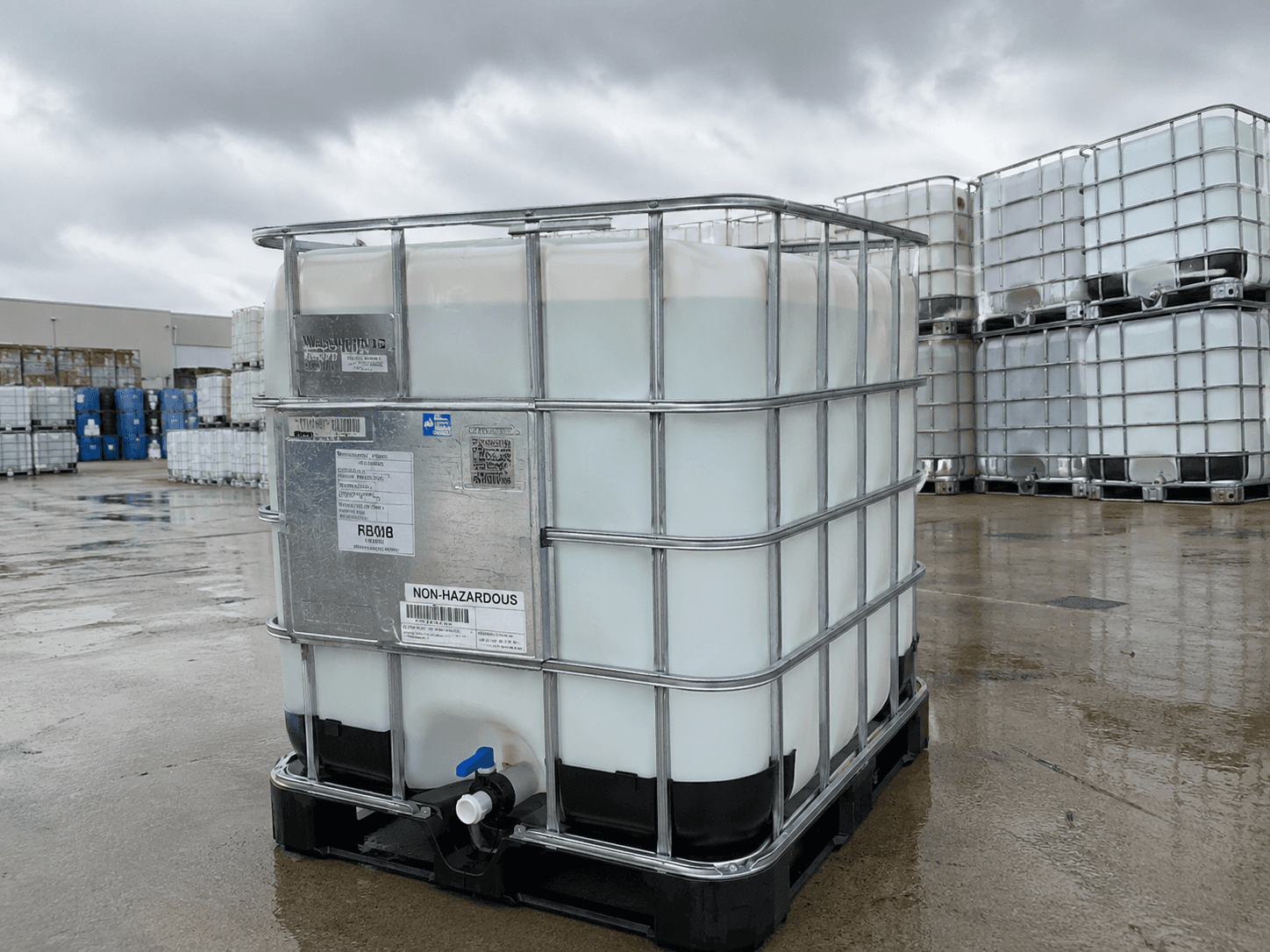
Stack of IBC totes at our Columbia, MO yard
On the yard · today

Real totes. Real photos. Sent before they ship.

Every order we quote is on a unit currently on our pad in Columbia, MO. Ask for a photo before pickup — we'll send one of the actual pallet, not a stock image.

The eco math

Reusing one IBC tote is roughly equivalent to…

Building a new 330-gallon composite IBC takes about 120 lb of HDPE plastic and 25 lb of steel cage. Avoiding that production is not abstract — it is measurable mass, energy and water.

  • 360 single-use water bottles kept out of landfill, by HDPE weight equivalence.
  • 720 lb CO₂e avoided versus the embodied carbon of a freshly molded composite IBC.
  • ~580 gallons of process water saved compared to virgin HDPE production.
  • One full pickup-truck bed of steel kept out of the melt cycle (per ~8 cages).
Read the full charter →
Why this matters more than it sounds

The hidden HDPE problem

HDPE is technically one of the most recyclable plastics on earth. In practice, less than 10% of industrial HDPE gets recycled — because collection economics fall apart at small volumes. A single IBC tote on a loading dock is "not worth the trip" for most recyclers.

That is exactly the gap we sit in. We'll come for twelve. We'll come for thirty. We'll combine your load with three other dockyards on the way back. The tote stays in service or, at minimum, becomes feedstock with a documented chain of custody.

See the impact dashboard →
Use cases

Where our totes end up second.

All products →
Ag

Liquid fertilizer & molasses

Food-grade rinsed units for dairies, orchards, and row-crop operations across MO, KS, IA, AR.

Food

Bulk syrups & oils

Reconditioned with traceable wash records for food and beverage co-packers.

Homestead

Rainwater catchment

Cut-top conversions for off-grid water collection, gravity-fed irrigation, animal troughs.

Industrial

Solvent & coolant storage

Industrial-grade totes with valve and gasket swap for shop and small-batch manufacturing.

Build

Modular raised beds

Half-cut beds with the steel cage retained as a trellis or critter guard.

Energy

Off-road diesel storage

Cage-reinforced totes with locking valve covers for jobsite fuel.

Water

Greywater + aquaponics

Multi-tote cascades for backyard aquaponics, fish-vegetable closed-loop builds.

Disaster

Emergency potable storage

Cleaned food-grade units staged for community emergency response and shelter use.

A small unfair advantage

We answer email like it's 2004.

Most yards make you call. We don't have a phone. Send the form, get a real person, get a quote — usually the same day, always within one business day. If that sounds backwards, you have never tried to get a real freight quote at 4:47 pm on a Friday.

Contact Us →
Frequently asked

The questions we get every week.

Full FAQ →
Are your used IBC totes food-grade?
Some are. Every food-grade unit we sell carries a wash record and a previous-contents declaration. If you need food-grade for human or animal contact, ask for it explicitly on the quote form — we won't guess.
How far do you deliver?
We regularly run loads across MO, KS, IA, AR, IL, KY, OK, NE, and TN. For loads over 12 totes we can ship anywhere in the continental US — freight is quoted per load, not per unit.
Will you pick up just a few used totes?
We pay for pickups starting at 12 units. Below that, you can drop off at our Columbia, MO yard during business hours, or we can route you to a partner yard. Either way, the tote does not go in the dumpster.
What if I have no idea what was in the totes I'm selling?
Tell us what you know, and what the operation was. We have seen most of it. If the previous contents are unknown, the tote goes to reconditioning or recycling — never resold as food-grade.
Orient yourself

The grade ladder — what each tier actually means.

Full inventory →
GradeWhat it isTypical priceBest forLink
Used — as-pulledRinsed once, last contents declared, cosmetic wear, sound cage.$75 – $115Non-potable water, gravel slurry, jobsite ballast.View →
ReconditionedTriple-rinsed, gasket and valve swap, cage straightened.$135 – $175Liquid fertilizer, industrial fluids, oils, soaps.View →
Food-grade (washed + record)ISO wash bay, traceable previous contents, swab tested.$185 – $235Syrups, edible oils, brewing, dairy ingredients.View →
Caged / specialtyReinforced cage, alternate valve, painted or wrapped.$155 – $210Diesel, ag chems, outdoor storage with UV exposure.View →
New (factory-sealed)Never filled, virgin HDPE, OEM cage and valve.$315 – $395Regulated processes, pharma adjacencies, audit trail.View →
Stainless304/316 SS jacketed totes, sourced on request.Quoted per unitSolvents, fragrances, high-temp processes.View →
Three numbers to know

If you only remember three things from this page.

$0.41
per gallon of bulk storage with a reconditioned 330, vs. $1.18/gal for a brand-new IBC.
720 lb
CO₂e avoided every time a single composite IBC is reused instead of newly molded.
26 hrs
median time from quote-form submission to scheduled pickup or delivery across our core 9-state radius.
93%
of incoming used totes leave our yard in a second life. The rest are documented through HDPE granulation.
From submit to dock

How it actually works, step by step.

Start a quote →
Step 01

You submit the form

One form, same one on every page. Counts, grade, ZIP, intended use. No phone tree, no callback request, no "an account manager will reach out."

Step 02

We pull the matching units

Within a few hours, one of us walks the yard, identifies candidate totes by lot, and tags them with your job number.

Step 03

Photographs go in the file

We take photos of each pallet — cage, valve, label residue, top hatch — and attach them to your quote so you see what you're actually buying.

Step 04

Quote out by email

Unit price + freight estimate + lead time. Usually same business day, always within 24 hours. You either confirm, counter, or walk.

Step 05

You confirm, we book freight

Owned trailer for in-region runs, vetted partner for longer hauls. We confirm carrier and pickup window in writing.

Step 06

Staging and load-out

Pallets stretch-wrapped, bottom-strapped, top-strapped. Two layers max for road freight, single layer for partial loads under 12.

Step 07

Ship and track

You get the BOL by email at pickup, an ETA the morning of delivery, and a real human responding to questions in between.

Step 08

Delivered, signed, done

Driver gets a signature, we get the POD, you get a follow-up email two days later asking if the units arrived as described.

Step 09

Impact gets logged

Your order is added to the running sustainability ledger — HDPE diverted, steel saved, CO₂e avoided. See the charter.

The freight math

Sample landed quotes — actual jobs, names removed.

DestinationQty / gradeFreightLanded per toteNotes
Springfield, MO8 × reconditioned 275$185$168Owned trailer, single layer, 2-day turn.
Wichita, KS24 × used 330$420$112Combined with a Liberal, KS drop on the return leg.
Cedar Rapids, IA40 × food-grade 275$675$203Full deck, two-layer, partner carrier, four-day window.
Fayetteville, AR16 × reconditioned 330$310$155Owned trailer paired with a Joplin reload.
Tulsa, OK60 × used 275$890$95Dedicated 53' reefer, two-layer with edge boards.
Memphis, TN20 × caged diesel-prep$540$184Partner carrier, lift-gate not required, dock-to-dock.

Quotes age. Diesel moves. Use these as a sanity check, not a price list. Send the form for a current number.

Anti-promises

What we won't do, on purpose.

  • No food-grade without a wash record. Ever. If a unit cannot be traced, it cannot be labeled food-grade. We'd rather sell it as industrial than guess.
  • No totes we haven't seen. We don't drop-ship from partner yards sight-unseen. If it's on your quote, it's on our pad in Columbia.
  • No hazmat resale. Pesticide, herbicide, and unknown chem totes get triaged to recycling. They are not flipped to homesteaders for water storage. Hard line.
  • No hidden freight. Quote shows units, freight, fuel surcharge, lift-gate if applicable, and lead time. One number to confirm.
  • No phone. Yes, really. See why →. Email keeps the paper trail and keeps the price honest.
  • No broker-only freight. We use either our own trailers or carriers we have a direct dispatcher relationship with. No load board roulette.
  • No surprise minimums. The pickup minimum is twelve totes, posted on every page. Below that, you drop off or we route you to a partner.
  • No upsell scripts. If a used unit fits your job, we'll quote a used unit. We are not commissioned on grade.
Geography

Where we run, how often.

Transportation details →
Weekly lanes
Columbia MO core, Jefferson City, Kansas City metro, St. Louis metro, Springfield MO, Lawrence KS, Topeka KS.
Biweekly lanes
Wichita KS, Joplin MO, Fayetteville AR, Bentonville AR, Des Moines IA, Cedar Rapids IA, Quincy IL, Peoria IL.
Monthly / on-request
Tulsa OK, Oklahoma City OK, Omaha NE, Lincoln NE, Memphis TN, Nashville TN, Louisville KY, Little Rock AR.
Counties we know by ZIP
Boone, Callaway, Cole, Cooper, Howard, Audrain, Randolph, Moniteau — and the surrounding 40 mile ring most days of the week.
Continental US (12+ totes)
Quoted as a full or partial load. Lead time typically 7–14 days depending on lane density.
Outside the lower 48
We don't ship to Alaska, Hawaii, or internationally. Not because we wouldn't — because we can't do it honestly at our scale.
Drop-off at our yard
1 – 11 totes welcome at the Columbia MO pad. Email first so someone is on-site with a forklift.
Partner-yard routing
If you're sitting on 2-3 totes outside our radius, we keep a short list of reputable yards we'll point you toward at no markup.
A worked example

How a single tote actually spends its second life.

Pick one tote. Call it Unit 4471. It started out in 2019 as a brand-new composite IBC at a soap manufacturer outside St. Louis — filled with liquid coco-glucoside surfactant, shipped to a co-packer in Springfield, emptied over three weeks, and stacked next to a loading dock with 23 of its siblings. The co-packer's plan was the standard plan: pay a hauler $40 a unit to make them disappear. The dumpster would have charged $0.18 a pound to landfill the plastic.

We picked them up on a Wednesday in October. Our trailer, two-layer, strapped with edge protectors. Back to Columbia by 4pm, on the pad by 5. Triple-rinsed in our wash bay the next morning — the surfactant was already water-soluble, so the wash record was clean within forty minutes. Cage straightened, gasket replaced, valve swapped, photographed, listed.

Unit 4471's second life was a homestead in Audrain County, MO — bought alongside three others for rainwater catchment off a pole barn roof. Three years there. When the homesteader moved, she emailed us. We came back, picked up all four, rinsed them, swapped the UV-fatigued gasket, and they went out again — this time to a cattle operation in southwest IA for non-potable water hauling.

That was Unit 4471's third life. The fourth, if there is one, will probably be as a cut-top planter or a biofilter at a small produce farm. Eventually the HDPE will fatigue beyond rinse-and-reuse — UV, freeze cycles, hot fill, takes its toll. When that happens, the shell goes to our granulation partner in St. Louis and the cage goes to scrap. The carbon math on Unit 4471, by then, will have paid itself back ten times over.

That's the loop. Our story →

The crew

Three people. One inbox. That's the operation.

About us →
Founder · 2017

Riley Marchetti

Started the yard with a $1,200 forklift, a leased pad, and a Craigslist ad. Handles buying, freight dispatch, and most of the email. Drives the truck when the lane is in-state.

Wash bay · joined 2019

Theo Branham

Runs the reconditioning line. Writes the wash records, manages the triple-rinse log, decides what gets bumped from food-grade to industrial. Used to inspect for a dairy co-op.

Logistics · joined 2022

Priya Sundaresan

Routes the freight, vets the carriers, balances the load board against owned-trailer capacity. Also the person you'll hear from on most quote follow-ups. Fan of color-coded spreadsheets.

The receipts

Cumulative impact, since the doors opened in 2017.

Methodology →
31,200+
used totes diverted from landfill, reconditioned, or routed to documented recycling.
3.74 M lb
HDPE plastic kept in service or returned to material stream rather than buried.
22.4 M lb
CO₂e avoided, measured against virgin composite IBC production baseline.
780,000 lb
structural steel kept out of the melt cycle through cage reuse and direct scrap routing.
Side by side

The five-grade comparison — pick the lowest tier that fits.

Size guide →
GradeWhat it isTypical priceBest forWash record
Used — as-pulledSingle rinse, sound cage, cosmetic wear OK.$75 – $115Ballast, gravel slurry, non-potable water.Previous contents declared only.
Cleaned (industrial)Double rinse, valve and gasket checked.$110 – $145Industrial fluids, soaps, oils.Wash type logged, not certified.
ReconditionedTriple rinse, full hardware swap, cage trued.$135 – $175Liquid fert, cleaners, processing aids.Lot-traceable wash record.
Food-gradeISO wash bay, swab tested, hardware new.$185 – $235Syrups, edible oils, brewing, dairy.Full record + previous contents affidavit.
New (factory-sealed)Never filled, OEM hardware.$315 – $395Regulated, audit-bound, pharma adjacent.Mill cert + factory seal.
Who buys from us

Customer types we work with most.

Co-packers

Beverage, sauce, and personal care

Food-grade reconditioned units with wash records, plus pickup of empties on a standing route.

Ag operations

Row crop, orchard, dairy, livestock

Liquid fertilizer, molasses, foliar, and water hauling. We know the seasons and stage inventory accordingly.

Municipal & utility

Public works and emergency response

Potable-staged units for shelter response, plus non-potable for street and parks departments.

Homesteaders

Rainwater, gardens, livestock

Small orders welcomed at the yard. Cut-top conversions and stand kits available.

Jobsite & construction

Diesel, water, equipment wash

Caged units with lockable valves and forkable pallets. Pickup at job completion offered.

Sustainability teams

Corporate ESG and reuse programs

Documented diversion with chain-of-custody, suitable for Scope 3 inventory and reuse audit reporting.

Ballpark pricing

What you should expect to pay, by order size.

Quote me →
1 – 11 totes

Yard pickup tier

$95 – $235 per unit by grade. Pick up at the Columbia pad, bring straps, leave with a receipt. No freight applied.

12 – 35 totes

Partial-load tier

Unit price holds, freight typically $310 – $620 within the 9-state radius. Owned trailer or vetted partner.

36 – 100 totes

Full-load tier

Volume discount kicks in at 36 units. Freight runs $620 – $1,150 depending on lane and grade mix.

100+ totes

Project tier

Quoted as a project with staged drops. Standing-order discounts available. Contact us for the volume sheet.

From the dispatch board

Recent shipments — names removed, details kept.

Jun 17

32 × reconditioned 275 → Lenexa, KS

Personal care co-packer, standing quarterly drop, owned trailer one-day turn.

Jun 14

18 × food-grade 330 → Ozark, MO

Craft maple-syrup operation, swab-tested batch, full wash records emailed pre-load.

Jun 11

54 × used 275 → Sioux City, IA

Row-crop operation, water hauling, partner carrier, paired with a Council Bluffs reload.

Jun 09

12 × caged diesel-prep → Rolla, MO

Highway contractor, locking valve covers, forkable double-pallet, lift-gate delivery.

Jun 06

26 × reconditioned 330 → Conway, AR

Greenhouse op switching to in-house fertilizer mixing. First order, expected to repeat.

Jun 03

9 × used 275 → yard pickup, Columbia MO

Homesteader rebuild after spring storm. Below freight minimum, picked up in a flatbed trailer.

Long-form FAQ

The other questions we get every week.

All FAQs →
What is the actual minimum order for a pickup at our facility?
Twelve totes for free pickup within our 9-state radius. Eight or nine if you're on an existing lane and the timing lines up. Below that, you can drop off at our Columbia MO yard, or we'll route you to a vetted partner yard at no markup.
Can I get food-grade if you don't have a wash record?
No. We will not sell food-grade without traceability. If you need food-grade right now and we don't have a unit with the right record, we'll tell you — and we'll quote a new sealed unit instead so you have a clean audit path.
How do you take payment?
ACH for established accounts, credit card via invoice for first-time orders (with the standard processing fee passed through), check on pickup if you're local. We don't take cash for amounts over $500.
What's the difference between "used" and "reconditioned" on your site?
Used means single-rinsed with previous contents declared. Reconditioned means triple-rinsed in our wash bay, gasket and valve swapped, cage straightened, and a lot-traceable wash record on file. The price difference is roughly $40 – $60 per unit.
What is the lead time on a typical order?
Quote within 24 hours of form submission. For in-region orders confirmed by Tuesday, we usually deliver same week. Out-of-region partial loads run 7 – 14 days. Full-load projects are scheduled by lane density.
Why don't you have a phone number?
Because email keeps the spec in writing, keeps the paper trail intact, and prevents the "you said what now" problem at the loading dock. Also because we're three people and the phone would never get answered honestly. Longer explanation →
Do you ship internationally or to AK/HI?
No. Not because we don't want to — because we cannot do it honestly at our scale. We'd rather decline than punt you to a freight broker we don't know.
Can I buy just one tote?
Yes, at the yard. Email first so a forklift is on site, bring straps, and bring a trailer that can take a 40 × 48 pallet. We don't ship single units freight — the math doesn't work for either of us.
What about pesticide totes?
They go to recycling, not resale. If you have a load of ag chem empties, we'll still pick them up — we just route the shells to documented HDPE granulation rather than the resale yard.
Do you offer recurring or scheduled service?
Yes. See the standing programs section below. Quarterly is most common, monthly for high-volume co-packers, bi-monthly for ag operations on planting and harvest cycles.
Spec sheet

275 vs. 330 — the quick reference.

Full size guide →
Spec275 gallon330 gallon
Capacity275 US gal / 1,040 L330 US gal / 1,250 L
Footprint40 × 48 in40 × 48 in
Height46 in53 in
Empty weight~125 lb~145 lb
Filled weight (water)~2,420 lb~2,900 lb
Pallet materialComposite / steel / woodComposite / steel
Standard valve2" ball, S60×6 thread2" ball, S60×6 thread
Top fill opening6" vented cap6" vented cap
Cage16 ga galvanized steel14 ga galvanized steel
Stack rating (filled)2 high static2 high static
Typical use caseSmaller batch, shorter ops, jobsiteBulk storage, ag, longer-term
The longer answer

Why no phone, really.

The short answer is that we're three people and a phone we couldn't answer honestly would be worse than no phone at all. The longer answer has three parts and is worth a minute of your time, because it shapes everything else about how we work.

First: email keeps the spec in writing. When you tell us "food-grade, 24 units, by Friday," that sentence becomes a file. The quote is a file. The wash record is a file. The BOL is a file. When something goes sideways — and freight always eventually goes sideways — the paper trail is the truth, not somebody's recollection of a Tuesday afternoon call. That matters for you, it matters for us, and it matters for the audit team your purchasing manager eventually has to answer to.

Second: the phone selects for the wrong customers. We have learned, over roughly eight years of doing this, that the customers who insist on a call before quoting are disproportionately the customers who haggle on freight after the load is on the trailer, who claim damage that wasn't there, and who treat the yard like a brokerage. The customers who are happy to email are, statistically and consistently, the customers we want.

Third: it's honest about scale. We are three people. We move thirty-something loads a month. If we pretended to staff a call center, we'd be pretending. We would rather be honest about what we are — a small yard with a real inbox and a real forklift — than perform a size we are not.

What we believe

The short version, on a wall in the office.

01

A tote is not garbage.

It's the most efficient bulk container ever made. Throwing one away is a failure of imagination, not a fact about the container.

02

The lowest tier that fits.

We will quote the cheapest grade that does your job. We're not commissioned on grade and we don't want to be.

03

Paper trail or it didn't happen.

Wash records, BOLs, POD, diversion logs. If we say we did it, the file exists. If we can't produce it, we won't claim it.

04

Honest about scale.

Three people, one pad, owned trailer plus partner carriers. We are not a national network and we won't pretend to be.

05

The loop, not the sale.

We'd rather sell you the right used unit twice than the wrong new one once. Repeat customers are the business model.

Press & recognition

People have written about us, occasionally.

Press · 2024

Springfield Daily News

"The small Columbia yard quietly diverting a quarter-million pounds of plastic a year." Local business feature, March 2024.

Member · since 2021

Missouri Sustainability Council

Verified member of the state sustainability cooperative, reporting annual HDPE diversion through their open ledger.

Award · 2023

Boone County Small Business Honor Roll

Recognized for waste diversion and rural reuse infrastructure. We were as surprised as anyone.

Feature · 2025

Mid-Missouri Public Radio

Segment on industrial reuse economics and why HDPE recycling fails at the small-volume tail. Aired April 2025.

Speaker · 2025

Midwest Reuse Network

Riley spoke at the Midwest Reuse Network conference on operating a profitable small-format industrial reuse yard.

Listed · 2026

Reuse Atlas (US)

Listed as a verified industrial-container reuse operator in the open-source Reuse Atlas for the south-central region.

Standing programs

Recurring service, set once, runs quietly.

All services →
Monthly

Co-packer empties pickup

For beverage, sauce, and personal-care co-packers running 30+ totes a month. We arrive on a fixed day, swap empties for clean reconditioned units, leave a paper trail.

Quarterly

Sustainability-team diversion log

For corporate ESG teams that need quarterly HDPE diversion numbers with chain-of-custody. We send a CSV plus a one-page executive summary.

Seasonal

Ag operation plant + harvest

Pre-staged delivery in March/April for liquid-fert season, pickup of empties post-harvest. Standing slot on the dispatch board, no quote required after year one.

On-call

Municipal emergency response

For city, county, and Red Cross-affiliated response teams. We hold a small bank of food-grade potable-ready units staged for fast deployment.

Annual

Facilities clear-out

For manufacturing facilities accumulating empties across the year. One scheduled pull, full diversion documentation, single invoice.

Custom

Build us a program

If none of the above fits, email us and describe the operation. We'll put a recurring schedule on the board and price it as a contract, not a series of one-offs.

Methodology footnote

How we get to those impact numbers.

The CO₂e and HDPE figures on this page are calculated from per-tote material inventory (120 lb HDPE shell, 25 lb steel cage) multiplied by published cradle-to-gate emission factors for virgin HDPE (1.95 kg CO₂e/kg) and galvanized steel (2.3 kg CO₂e/kg). Diversion totals are pulled from our internal lot log. Spreadsheet, sources, and the math are linked from the sustainability page.

Read the methodology →
Request Quote