The beginner's
guide to the
humble IBC tote.
If this is the first time you've seriously looked at IBC totes, start here. Forty minutes of reading saves you weeks of trial and error — and probably keeps a tote out of a landfill.
What is an IBC tote, actually?
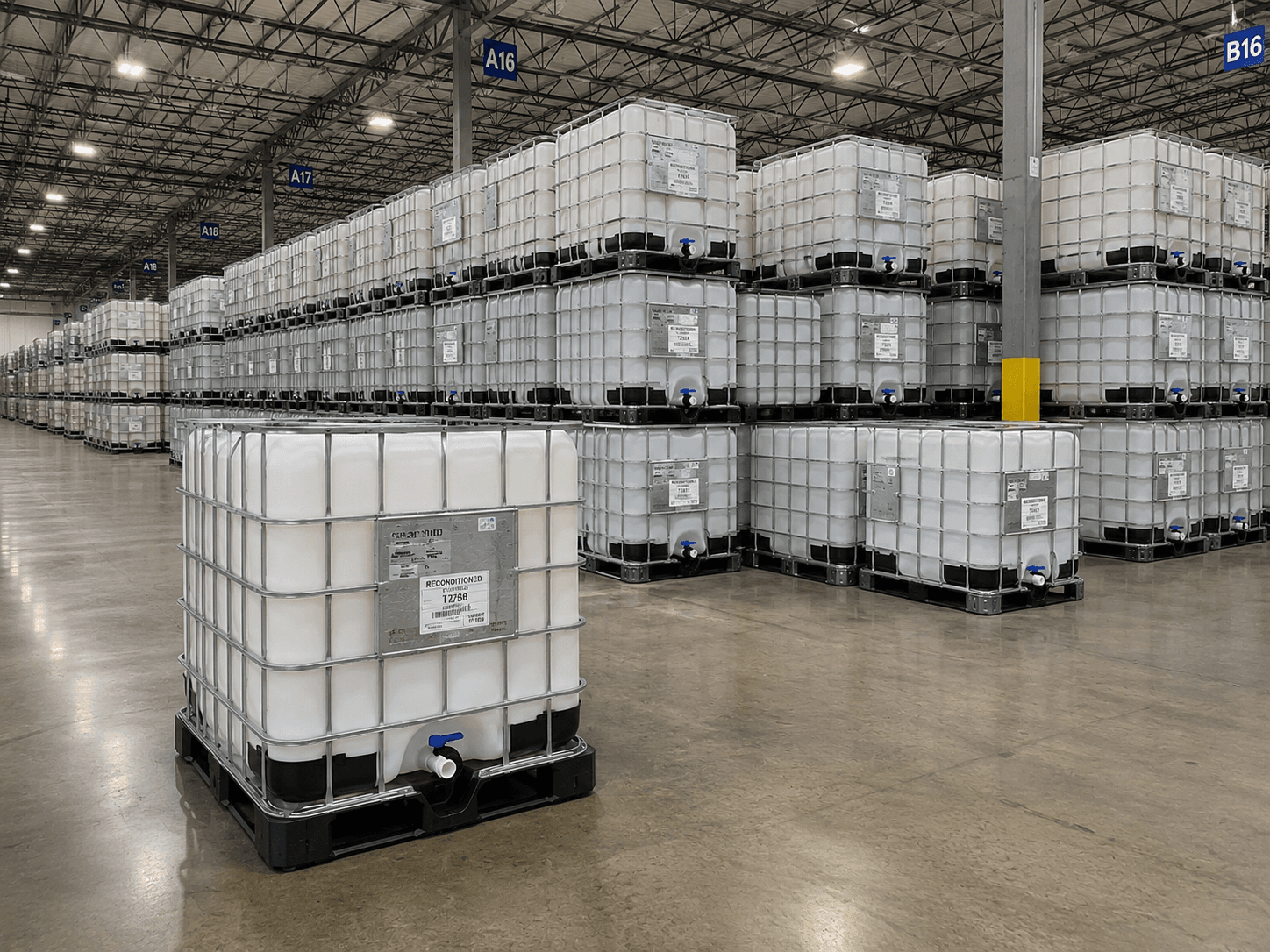
An Intermediate Bulk Container — almost universally shortened to IBC, almost universally called a "tote" in North America — is a reusable industrial container designed for the bulk handling of liquids and bulk solids. The classic configuration is a blow-molded HDPE plastic bottle inside a galvanized steel cage, sitting on a pallet. The whole assembly is roughly cube-shaped and holds either 275 or 330 US gallons.
The point of the IBC is that it is the "Goldilocks" container: too big to be a drum (which only hold 55 gallons), too small to require a fixed tank, but big enough that the math of bulk handling works out. One IBC = six drums in capacity = the smallest economical bulk shipment for most industries.
The two sizes you will see
- 275 gallon — a 46-inch tall tote on a standard 40×48 pallet footprint. Slightly shorter, slightly lighter.
- 330 gallon — a 53-inch tall tote on the same footprint. The capacity-leader.
Both fit standard pallet jacks and forklifts. Both can be stacked two-high when filled. They differ almost entirely in height — which matters if you are stacking under a low ceiling or fitting one into a trailer with limited vertical clearance.
The five grades you will be quoted
The single biggest source of confusion for first-time IBC buyers is grade. Every dealer uses slightly different language, but the underlying categories are the same:
- New. Never filled. The most expensive, and over-spec for most uses.
- Reconditioned. Used once, then hot-washed, re-gasketed, re-valved, and certified. The smart-money choice for almost all applications.
- Rinsed. Used once, rinsed with water. Lower price, cosmetic blemishes allowed, prior contents declared.
- As-Is. Used, not washed by the seller. Cheapest reusable grade.
- Recycle-only. End of life. Sold by the pallet to material recovery.
Food-grade is not a grade — it's a certification
"Food-grade" is overlaid on top of the grade. A reconditioned tote can be food-grade if it has been hot-washed with food-safe detergent and carries a wash record. A used tote, even one that previously held something edible, is not food-grade unless it has gone through that wash certification.
If your application is anything human or animal edible, anything pharma, or anything with a regulator looking over your shoulder — specify food-grade explicitly. Don't assume.
Common first-time-buyer mistakes
- Buying new when reconditioned would do. The default for ~90% of applications should be reconditioned. New is over-spec for most uses.
- Underestimating freight. Get landed cost, not unit cost. A cheap tote three states away is not a cheap tote.
- Storing outdoors uncovered. UV degrades HDPE within a year. Cover or paint.
- Not checking the cage. Bent cages cause stacking failures. Inspect — or ask for a photo.
- Forgetting the gasket. An eight-year-old gasket will leak. Replace gaskets on every used purchase. They are cheap.
What to do next
If you have a specific use in mind, head to the products pageand pick a grade that matches. If you want more detail on dimensions, freight, and stacking, the size guide has the full reference. If you have questions we haven't covered, the FAQprobably does — and if it doesn't, send us the question on the form. We'll answer.
How to pick a grade in under two minutes.
Read the four questions in order. Stop at the first one that lands on "yes," and the answer is your grade.
- Is the content human or animal edible, pharma, or under FDA / USDA review? Reconditioned food-grade. Don't negotiate this one with yourself.
- Is the content a non-edible commercial liquid that needs to look professional on a customer's dock? Reconditioned (non-food). Same wash standard, less paperwork.
- Is the content for your own use, on your own property, where appearance and certification don't matter? Rinsed. You'll save 20–30% and still get a perfectly usable tote.
- Do you need 30+ totes and you're willing to inspect on receipt? As-is. Bring a wrench and a gasket pack; you'll come out ahead.
"New" isn't on the list because the question that gets you to new is narrow: regulator demands it, customer demands it, or contents are reactive enough that any prior residue is unacceptable. About one in twelve customers ends up there. The rest of the world is reconditioned.
Seven things we hear weekly that aren't true.
"Used totes are unsafe."
A washed and re-gasketed tote is statistically safer than a new tote in the same service — because the wash bay catches manufacturing defects new doesn't. Used is fine. Unwashed unknown is the actual problem.
"The cage is just for shipping."
The cage carries the stacking load and protects the bottle from impact. A tote without an intact cage is a one-trip container. Don't buy a tote with a bent cage and assume you'll just "use it standalone."
"Food-grade lasts forever."
Food-grade is a certification at a point in time, not a lifetime property. The minute you put a non-food contents in a food-grade tote, it stops being food-grade. The certification doesn't come back without a re-wash.
"HDPE doesn't degrade."
HDPE is durable in service but UV-sensitive in storage. An uncovered Missouri summer chalks the surface in 12–18 months. Cover, paint, or shade if the tote will sit outdoors.
"All gaskets fit all valves."
EPDM, Viton, silicone, and Buna-N look similar and behave very differently. Match the gasket to the contents and the temperature. Wrong gasket is the #1 cause of small-leak callbacks.
"The 330 is just a taller 275."
Roughly true on geometry, very not true on stacking math. The 330 stacks higher, weighs more filled, and clears fewer trailer doors. Pick on capacity AND on your ceiling clearance.
"Plastic recycling is a lie."
For consumer mixed plastic, sort of. For mono-stream industrial HDPE coming from a known-contents fleet, no — this is one of the few plastic streams that actually recovers cleanly. We move ours to verified granulators.
Twenty-five words you'll hear on your first call with a dealer.
| Term | Plain-language meaning |
|---|---|
| IBC | Intermediate Bulk Container — the 275 or 330 gallon cube. |
| Tote | The North American nickname for an IBC. Same thing. |
| HDPE | High-density polyethylene. The plastic of the inner bottle. |
| Cage | The steel grid wrapping the bottle. |
| Bottle | The inner blow-molded HDPE container. |
| Pallet | The bottom platform — plastic, wood-composite, or steel. |
| Foot | One of the corner supports of the pallet. |
| Valve | The 2" or 3" ball valve at the bottom. |
| Cap | The top fill port closure. Usually 6" vented. |
| Vent | The pressure-equalization passage in the cap. |
| Fitment | The thread or quick-connect adapter on a port. |
| NPT | National Pipe Thread — tapered, standard in North America. |
| BSP | British Standard Pipe — common on Euro totes. |
| Cam-lock | Lever-action quick-connect coupling. |
| Gasket | The rubber sealing ring at every threaded joint. |
| EPDM | Ethylene propylene diene monomer rubber. Water-friendly. |
| Viton | FKM elastomer. Solvent-friendly. Pricier. |
| UN-rated | Certified by DOT-recognized testing for hazard transport. |
| Tare | Empty weight of the tote. |
| Gross | Filled weight (tote + contents). |
| Wash record | The signed document logging a reconditioning batch. |
| Recon | Shorthand for reconditioned. |
| Granulation | Shredding HDPE into flake for recycling. |
| Lift-gate | Hydraulic delivery platform for sites without a dock. |
| Double-stack | Two totes high in a trailer. |
Three short case studies, end to end.
1,200 sq ft roof in central MO.
Annual rainfall ~42". Capture potential (75% efficiency) ≈ 28,000 gallons/year. With a peak two-month dry stretch and 35 gal/day household demand, ~2,100 gal of storage smooths the gap. Three 275s do the work; we recommend rinsed grade with a fresh gasket, covered, on a level pad.
Six totes for row-crop herbicide.
Mid-Missouri corn/soy, two-pass application, ~600 acres. Six 330s in a rotating fleet: three filled, three at the dealer being refilled. Reconditioned (non-food) is the right grade. Viton gaskets if running glyphosate plus 2,4-D combo. Budget ~$1,650 landed.
Single recon for a 7-bbl brewer.
Logboat-scale brewer in Columbia, single tote of propylene glycol coolant on a closed loop. One reconditioned food-grade unit, EPDM gaskets, painted to block UV (it's outside the back door). About $385 with delivery. Replaces a leaking 1990s steel drum that nobody wanted to disassemble.
The five we see, in detail.
1. Buying new when reconditioned would do.
A reconditioned tote at $185 does the same job as a new tote at $425 for roughly 90% of applications. The reflex to buy new comes from a (reasonable) fear of residue — but residue is what reconditioning removes. Reconditioned with a wash record gives you the same hygiene at less than half the cost and roughly one-tenth the embodied carbon. Default to reconditioned.
2. Underestimating freight.
We've seen customers chase a $20-cheaper tote three states away and pay $90 more in freight per unit to get it. Always quote landed cost. A 26-tote FTL from our yard to Tulsa runs roughly $14/tote in fuel; the same shipment LTL from a competitor in Ohio can be triple that. The cheapest tote is the one closest to your dock.
3. Storing outdoors uncovered.
UV is the silent killer. We've pulled HDPE samples from totes left in the sun for 18 months and they fracture in your hands at the corners. Tarp, paint, or build a simple shade roof. Even a layer of grain-sack burlap drops the UV-degradation rate by ~70% in our informal field tests.
4. Not checking the cage.
A tweaked cage doesn't look bent until you try to stack on it. Look at the four bottom welds and the diagonals. If the diagonals are visibly off-90°, walk away — or get a price that reflects single-tote use only.
5. Forgetting the gasket.
Stock EPDM gaskets are good for about five years in service. An eight-year-old gasket on a tote you just bought is probably the leak you'll have next spring. New gaskets are $1.20 each in tens. Replace on intake.
Reading paths after 101.
Long-form articles
Food-grade rules in detail, rainwater sizing math, the freight matrix walkthrough, UV in year two.
The size guide
Dimensions, weights, fitments, stacking max, the freight matrix — in one printable page.
The FAQ
Thirty-plus questions in six categories. Updated whenever a question hits three customers.