The reference
library nobody
else writes.
A beginner's guide for first-time buyers, deep-dive articles on niche use cases, and a no-nonsense FAQ. We add to these every month — usually after the third customer asks the same question.
IBC 101 — The Beginner Guide
If this is your first IBC tote, read this. Anatomy, grades, capacities, when-to-use-what.
Articles & Insights
Long-form pieces on food-grade rules, sizing rainwater systems, lifetime math, and the politics of HDPE recycling.
Frequently Asked Questions
The thirty questions we get most. Updated quarterly with whatever's come up.
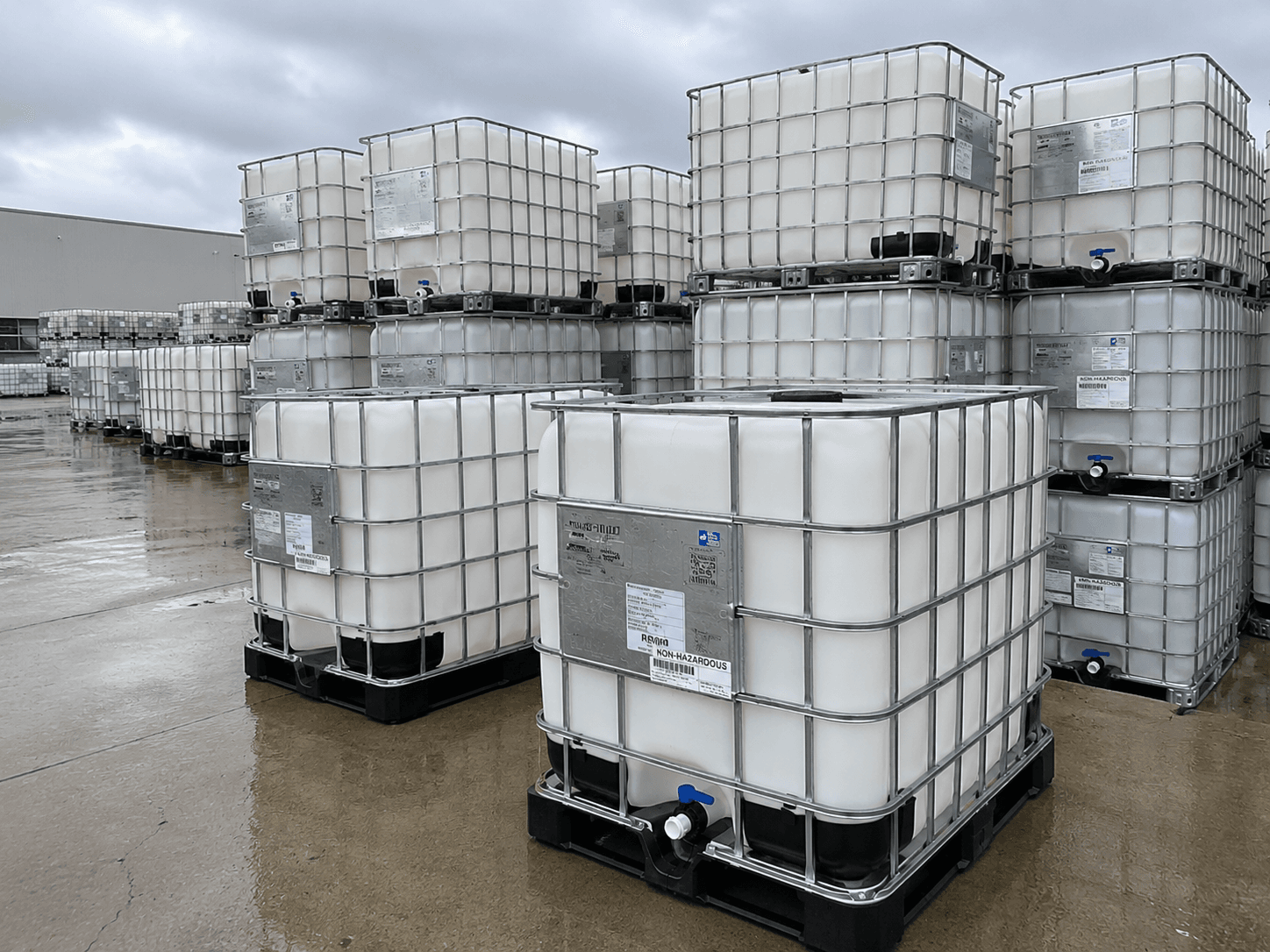
Five reading paths, by what brought you here.
You've never bought a tote.
Read IBC 101 end to end, then the FAQ "Buying" section, then the size guide. About 45 minutes total. You'll skip every classic first-buy mistake.
You report on the carbon and waste numbers.
Skip 101. Read the Sustainability Charter, then the recycling articles, then the FAQ section on Sustainability claims. About 35 minutes.
Spray, fertilizer, irrigation, livestock water.
IBC 101 grades section, freight matrix in the size guide, fitments article, FAQ on selling back at end of season. Maybe 30 minutes.
Rainwater, off-grid water storage, hugelkultur.
Rainwater sizing article, valve and fitment article, the "UV and outdoor storage" piece. About 40 minutes — longer if you start measuring your roof.
You buy at scale and need landed cost.
Freight matrix and trailer math in the size guide, the "Transportation" FAQ, the article on double-stacking constraints. Twenty minutes if you skim.
You read the about page and want more.
Skip everything structured. The blog is the long version of who we are. Start with the most recent post and work backward when something catches your eye.
The four pages we open more than any other.
Size & capacity table
275 vs 330 in inches, mm, and gallons. Pallet footprint, weight filled, weight empty, stacking max.
ReferenceFitments & threads
S60x6, 2" NPT, 3" NPT, cam-lock adapters, EPDM vs Viton — the matrix we keep printed on the wash-bay wall.
ReferenceFreight matrix
Totes-per-trailer for empty, rinsed, and filled across dry van, flatbed, and conestoga. Lift-gate notes included.
ReferenceValve compatibility
Which valve fits which cage. The bolt-pattern story we wish someone had told us in 2018.
What changed in the last few weeks.
FAQ — Buying section
Added five new entries on card surcharges, photo guarantees, freight quotes, and single-tote yard pickup.
Size guide — freight matrix
Re-checked numbers after Q1 trailer measurements. Two correction lines on conestoga heights.
Article — UV degradation in year two
Field notes from a four-year outdoor cohort at the Ashland, MO farm we test against.
Article — Brewery glycol loop totes
A single-recon walkthrough for the Logboat-sized brewer. Costs, gasket choice, the small disasters.
IBC 101 — grades section
Cleaned up the "rinsed vs reconditioned" explainer. Added a side-by-side photo of a wash record.
FAQ — Payments section
New category. ACH, card thresholds, net-30 requirements, what we do with W-9s.
Tote vocabulary, in one place.
| Term | What it actually means |
|---|---|
| IBC | Intermediate Bulk Container. The 275 or 330 gallon cube most people call a "tote." |
| HDPE | High-density polyethylene. The plastic of the inner bottle. Resin code 2. |
| Cage | The galvanized steel grid around the bottle. Carries the stack load. |
| EPDM | The black rubber used for most stock gaskets. Good for water, bad for petroleum solvents. |
| Viton | FKM elastomer. Survives solvents and high temps. Costs roughly 6x EPDM. |
| NPT | National Pipe Thread (tapered). The threaded fitment on most North American totes. |
| S60x6 | The 60mm coarse-thread cap common on European-origin totes. Adapters available. |
| Cam-lock | Quick-connect fitting (Part A through F). The lever-action coupler you see on tankers. |
| Riser | A short vertical extension between cage and bottle, used on raised-pallet variants. |
| Dunnage | Boards, foam, or strap material used to immobilize totes in a trailer. |
| Wash record | The signed batch document recording detergent, temperature, dwell time, and operator. |
| UN rating | The four-character DOT-recognized stamp showing what hazard class the tote was certified for. |
| Reconditioned | Used once, hot-washed, re-gasketed, re-valved, certified, photographed. |
| Rinsed | Used once, water-rinsed. No detergent, no certification, lower price. |
| As-is | Used, not washed by the seller. Buyer takes it as it sits. Cheapest reusable grade. |
| Granulation | The mechanical shredding of HDPE into pellet-bound flake. End-of-life path. |
| LTL | Less-than-truckload freight. Cheaper for small loads, slower, more handling. |
| FTL | Full truckload. Faster, fewer touches, what we use for orders of ~26+ totes. |
| Lift-gate | Hydraulic platform on the back of a delivery truck for sites without a dock. |
| Double-stack | Two totes high in the trailer. Allowed empty/rinsed; not allowed filled with most liquids. |
| Pallet jack | The hand-pump pallet mover. Works on a standard tote if your floor is reasonably flat. |
"I just bought a used tote — what now?"
You drove home with one in the back of a pickup.
Inspect the cage at the joints, replace the gasket on principle, flush twice with clean water before any storage. Don't skip the cage check — tweaked frames stack badly.
You bought five for rainwater off a marketplace.
Ask the seller for prior contents in writing. If they can't tell you, treat as as-is and triple-rinse with detergent before potable use — or restrict to irrigation only.
You have a pallet of 26 sitting in a paddock.
Cover them — UV from a Missouri July is the fastest enemy. Tarp, paint, or shade. We've seen brand-new HDPE chalk to gray in 14 months uncovered.
You want to switch one to food-grade.
Honest answer: you can't make a used tote food-grade in a backyard. Ship it to us for batch reconditioning or buy one already certified. Don't mess around with this one.
The valve is stuck or weeping.
Two-inch ball valves are a five-minute swap with a wrench. Cam-lock end-caps are a thirty-second swap. We sell both as parts; ask in the form.
You want to scrap a dead one.
Don't just landfill it. We accept single-tote drop-off at the yard for a nominal recycling fee, or pair it onto a route pickup if you have neighbors with more.
How we write what we write.
Every reference in this library comes from one of three places: the wash bay (what we've seen in five-plus years of intake), the regulator (49 CFR for the US, GHS for hazard labels, FDA 21 CFR for food contact), or the manufacturer (Schütz, Mauser, Greif, Hoover-Ferguson spec sheets).
When the three disagree, we say so. When we're extrapolating from a small sample size, we say so. When something is a strong opinion rather than a fact, the sentence usually starts with "we think." If you spot a number that looks wrong, email it — we'll re-check and credit you in the changelog at the bottom of the page.