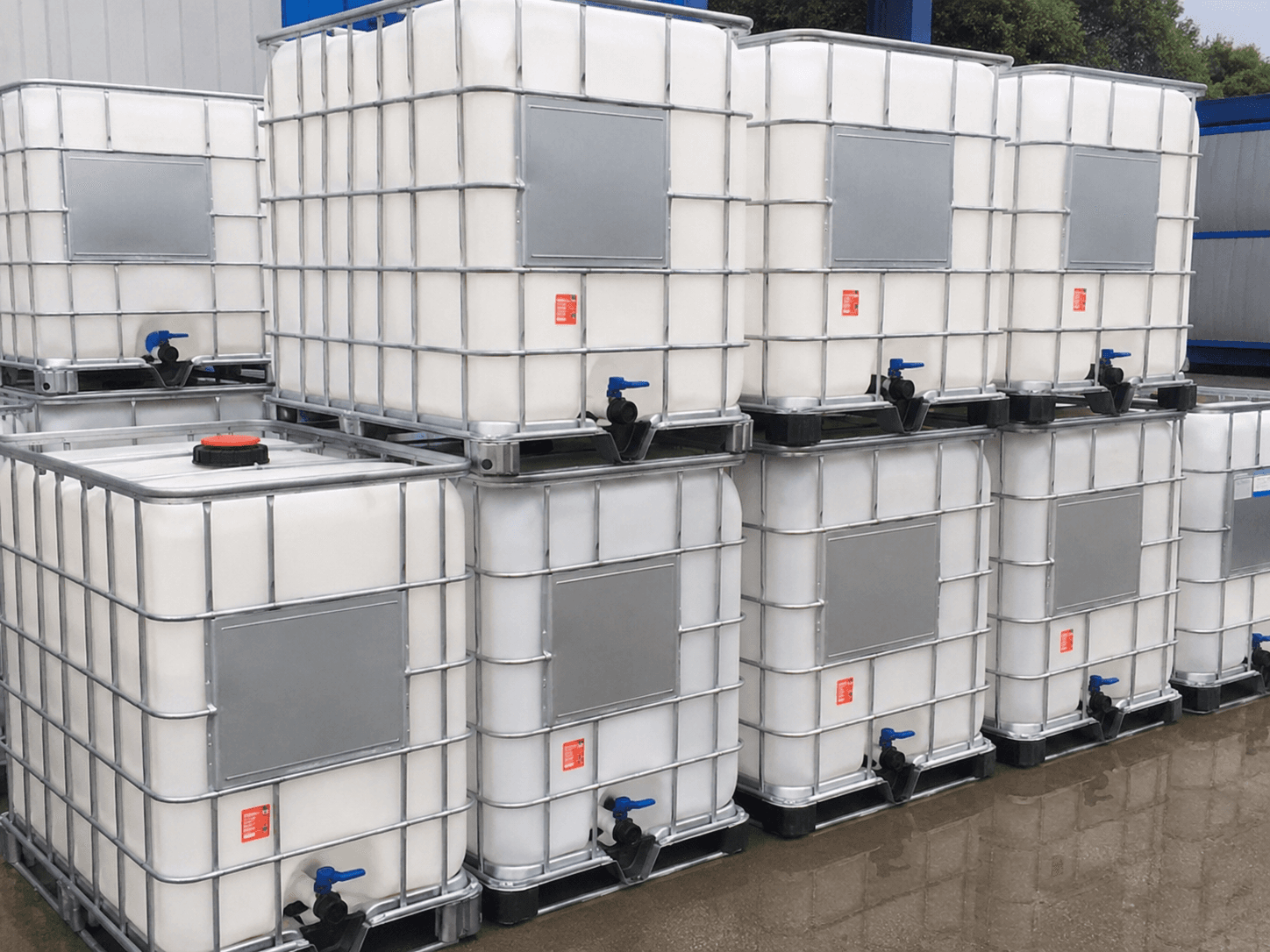
The honest answer to "how long does an IBC last?" is: as long as you respect what kills it. Manufacturers conservatively spec 5–7 years of useful life. Field-cared-for totes routinely make 15–20 years and we have seen well-stewarded units in service for 30.
What kills a tote
- UV degradation. Sun-faded HDPE becomes brittle. A tote stored uncovered outdoors for two summers loses meaningful structural integrity.
- Aggressive solvents. Aromatic and chlorinated solvents permeate HDPE over time — even compatible-looking products can shorten lifetime if continuously stored.
- Cage failure. Bent cages from rough handling. A failed cage almost always means the bottle goes too — the bottle is not self-supporting at filled weight.
- Freeze. Frozen water expands; a frozen filled tote will crack the bottle and/or burst the cage.
- Stress cracking near fittings. Mishandled valve installs put stress on the HDPE around the outlet. Eventually leaks.
What extends a tote
- Cover or paint for UV protection.
- Match material to product chemistry — use stainless for solvents, HDPE for water/ag/most food.
- Replace gaskets at every reconditioning.
- Store filled totes off-frost, on level surfaces.
- Don't double-stack filled.
The lifetime math
A new tote that survives 20 years of repeated reuse handles roughly 80 filled cycles at typical 3-month cycle time. That is 26,000 gallons of bulk liquid storage per tote, lifetime. The embodied carbon cost spread across 26,000 gallons is essentially negligible — which is the whole argument for reuse over single-use.